





















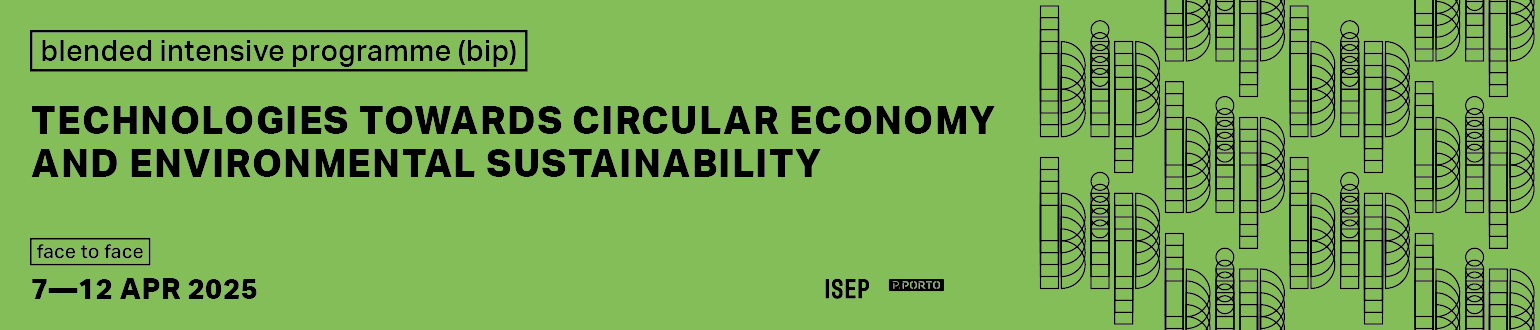
Technologies towards circular economy and environmental
sustainability
Virtual Component Duration: 10th to 21st March 2025
Physical activities: 7th to 12th April 2025
Venue: Porto, Portugal
EU Priorities Addressed
Environment and fight against climate change
Strategy on green transition and sustainable development
Objectives and Description:
I- Designing processes to convert raw materials into valuable products sustainably, while minimizing environmental impact; green engineering & green chemistry; carbon capture technologies; sustainable and biodegradable materials; recycling technologies.
II- Holistic approaches to designing and managing complex biosystems with sustainability and circularity in mind; optimizing resource flows, integrating circular principles in product and process design, and managing sustainability in supply chains.
III- Optimizing production processes and systems for efficiency, productivity, and sustainability, circular supply chains, and life-cycle assessment of products and processes.
IV- Environmental protection, pollution control, waste management, and sustainable resource use and circularity.
Participants (Learners) /students/staff/Teaching staff)
Bachelor, Master and PhD students from Chemical Engineering, Bioresources Engineering, Environmental Engineering, Industrial Engineering and related areas.
Methods:
- On-line lectures
- Work collectively and simultaneously as a team on specific projects to tackle challenges concerning circular economy and environmental sustainability.
- Hands-on multidisciplinary projects
Outcomes:
- Increased awareness of circular economy principles
- Foster teamwork and multidisciplinary collaboration through laboratory-based projects and real-world environmental challenges
- Build in-depth knowledge about xenobiotics, their environmental impact, and the need for innovative detection methods and to better manage pollution and mitigate its impacts on ecosystems and human health.
- Practical skills in sensor design and development
- Understanding of Life Cycle Assessment principles, framework and familiarity with LCA standards
- Acquire skills in LCA software tools such as OpenLCA to perform assessment
- Critical Thinking for Decision-Making to support sustainable product design, policy recommendations, and business strategies
- Assess key metrics, such as carbon footprint, water use and pollution, resource depletion and ecosystem impact
- Develop critical thinking skills to evaluate and integrate nanomaterials into the creation of advanced analytical tools for environmental monitoring
- Identification of the most effective green extraction method for bioactive compound recovery from the food processing waste.
- Assessment of the potential applications of the extracted compounds in industries such as food, cosmetics, or pharmaceuticals.
- Enhanced understanding of the environmental and economic benefits of waste valorization for sustainable development.
- Develop practical skills in integrating experimental techniques with environmental sustainability assessments and optimization strategies.
Programme Coordinators: Simone Morais & Paula Silva


